
What Goes Up Must Come Down.....Les Ecluses

The journey along this canal was very pleasant, though somewhat weather influenced too!
Once we reached Joinville, and moored in a hotel's back garden, we started to experience more problems of the weed variety.
This generally meant that we would travel along a central channel which was less weedy but after a lock the boat would have to engage into reverse for a while to try to get rid of some of the material wrapped around the keel, rudder and propellar.
This slowed us down a little, but we weren't going too fast anyway, there are quite a few locks. Iseemed we would get through a lock, sit down for a bit, and then another lock would suddenly appear.
The locks generally worked fine, but with the increasing weed came more problems, with the lock gates getting jammed and so more calls to VNF who would send out their lock keepers to sort out the problem...as long as it wasn't lunchtime, a sacred time in France.
The toilet also became difficul to flush, weeed had managed to work it way into the pump! Left that one for Mike to sort out.......
At Joinville, we were joined by a few other boats, which was quite nice, and we even had a small sailboat rafted up next to us. The occupant was a German/Italian, though he preferred to be known as a Sardinian national , we couldn't quite grasp his name and he just became known as Sardii.
Poor Sardii had been much hampered by the weed, and whilst moored up had to strip down and dive under his boat to free weed from the engine cooler, something Mike was hoping to never have to do, and I certainly wasn't going to do so!
Joinville is known for its flowers, and has a lovely palace with very sculptured gardens which I visited with Sprocket.

It also rained a lot whilst we were here, but we were very snug on the boat and with our all weather gear which I am glad we brought with us.
From here until we reached the tunnel of Balesmes just after Langres we had been ascending the whole time, not by a huge amount but the canals generally follow the land contours and the lock is where the boat gets lifted up.
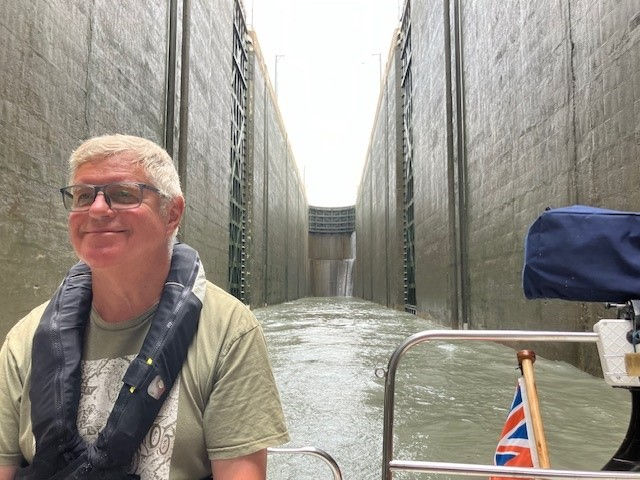
We have previously done boating holidays, and owned a boat on the Thames for a while and so weren't too phased by the locks, though the large industrial ones were quite daunting, especially when commercial traffic was in there with us.
A quick run down of the locks we have encountered
Ships, large barges, commercial barges and hotel barges have priority over plaisanciers (private boaters) and will enter the lock first, possibly filling it. We must keep out of their way, wait and be patient. There is no point overtaking any ‘commercial’ vessel anywhere near a lock.
Most locks of whatever size have signal lights.
Two reds – the lock is not currently available to you. You may have to wait some time, so moor up.
One red – the lock is not available, but will be shortly for example after the boats currently in the lock have left. Wait by mooring temporarily or by holding station in the water (but not close to the lock).
Red and Green – The lock is being prepared for passage from your direction. Wait but be prepared to move off.
Green – the lock is open and available.
Flashing orange or other colour – the lock operating system is aware of your presence (you have passed a sensor, pressed a remote control button or twisted a hanging rod perche).
Watch for a red/green light signal

Large and deep locks
The big locks on the Seine, Saone, Rhone etc are all controlled remotely by lock-keepers, normally from high up in a control tower located midway in the lock basin on one side or the other. The lock-keeper makes all operational decisions based on their understanding of approaching upstream or downstream traffic, its type and size. So a private boat (plaisancier) can be kept waiting for 20 minutes or longer if the lock is ready for a barge or ship expected in the other, or same, direction. If in any doubt, we moor at one of the pontoons providing access to the bank, maintain a VHF contact and await instructions, usually in French!
VHF
It is advisable to pre-announce arrival at a lock by VHF some distance away. This would generally be me on the radio saying
“ . . . écluse A, écluse A, ( A being my interpretation of the French pronunciation!) c’est bateau Ramukanji), bateau ‘Ramukanji’ , bateau de plaisance, montant (heading upstream) or avalant (heading downstream), Over . . “ For some reason I kept saying 'out' rather than 'over' which somewhat annoyed Mike , but it didn't seem to matter much in my opinion!

We were supposed to do this a few km in advance apparently, but we generally did it just as we saw the lock and it seemed to work just fine.
They would then tell us if we needed to wait for traffic, more often than not they would allow us to go in solo, which seemed such a lot of water to be using, but we think they were trying to lower the levels a bit due to all the rain.
Smaller Locks
Approaching a lock, on the remote control we push the upstream or downstream button. If the signal is received a light will flash and/or the lock’s traffic lights will change. Once in the lock, operation will be initiated through rods or by using another button on the remote control.
Perche rod- Suspended vertically over the canal is a perche, a length of heavy duty rubber tube. Grab the tube and twist the perche a half-turn and this also signals approach to the lock. Remember to walk along the boat deck as doing this otherwise it may unbalance you as the boat is moving forward!
In the lock
Once in the lock, there are two rods set vertically into the lock wall, connected to a gantry at the lock edge. One is red, the other blue. The red is for emergency use only, to stop any operation and communicate the situation to the waterway authority. The blue is lifted sharply to throw a switch in the gantry and start the gate/filling/emptying sequence. Ascending, the rod is always wet and slimy and difficult to grasp and lift.
On the locks on the canal entre Champagne et Bourgogne the remote control had a button to initiate this procedure. This made mooring in the lock much easier as we could moor where we found it easier rather than needing to be in reach of the perche.
In the smaller locks Ramukanji would enter, and lines would need to be put on at the stern and at the bow. Ascending locks we would have to do this using a boat hook, and often would not be able to see the bollard above and it was quite a trcky porcess if the lock depth was greater than 4 metres. Generally, this would be when Sprocket and I would cycle and I could then easily take the lines from Mike and control them from ground level as the boat would rise.


Descending locks were much easier, we would just need to lasoo the bollards as we entered, I became very proficient at lasoo throwing, a skill I am sure I shall find useful in future life!
Deep locks, floating bollards
The Rhone has enormous locks rising tens of metres, but they’re very easy since one loops onto bollards that rise with the water level (they also fill quietly and easily).The Seine and the Saone also had floating bollards and so also were quite easy, though did not have quite the depth of the Rhone locks.

Both bow and stern lines have to attach to the same bollard in equal lengths, or a mid-line (if available) may sometimes suffice, though we found it much easier to keep the boat stable once the water was moving with both bow and stern lines.
It is easy to catch the end of a fender board in the vertical slot in the lock wall that precedes or contains the bollard. Fenders can also slot into the slot and become ineffective, so we have to keep vigilant the whole of our time in the locks.
Matt the plank was put to good use in the locks and helped both to protect our fenders and also to prevent them disappearing into the large holes in the walls of the bigger locks.
Big locks, stepped bollards
These deep locks have inset bollards at intervals up the lock wall – not always set vertically one above the other. Bollard spacing – horizontally and vertically – suits barges, not small boats – this means it’s difficult/impossible to get a bow line to one bollard and a stern to another. You may have to ‘running moor’ or put both bow and stern round the same bollard (which naturally reduces control). Moving up from one bollard to the next requires timing and co-ordination. Lines have to be transferred (sometimes quickly, to keep control) from one bollard to the next as the lock empties or fills – it is quite easy for lines to slip off the top of slimy bollards as the boat rises, mid-ship cleat comes in handy in these circumstances, and sometimes we used ladders, though not strictly allowed.
Vertical poles
Substantial stainless steel poles inset in the lock wall, stretching from the lock floor up to the lock edge. Once taken around the pole and brought back, lines do not have to be adjusted and can be kept tight, sliding up or down as the boat rises or falls, simples.
Needless to say, we became quite good at taking the boat through the different locks we encountered!
The days on the canal entre Champagne et Bourgogne were pretty staight forward. The locks did not open until 0900 and so there was no need to rush, we could get upand take Sprocket for a walk, wander around the village or town , visit the boulangerie, perhaps have a coffee..
Prepare the boat for the day, not much to do really, check the bilges and weed collection areas, look at where we may want to end up or stop for lunch, and then cast off and continue along the canal.
This canal goes through some very rural parts of France, the weather was quite wet and on the days of sunshine we would see the farmers rushing to bring in the harvest working well into the night to take advantage of the good weather.

From Joinville we continued stopping at Villiers and Vouecourt, mooring on our own and quite rural and very quiet.
At Chaumont we stayed for two nights as we needed to do some victualling (shopping) and wanted to visit the viaduct which was a walk away on the eother side of town, and up a steep hill!
The mooring at Chaumont was alongside a concrete pier and there were two other boats with us , though they were heading the opposite direction from the Med to Sweden.
They had been in the med for several years and were carrying there masts with them. They were finding this annoying, being larger yachts the masts were difficult to prevent being banged around in the locks, also they had deep keels and had struggles with the depths and had to keep to the centre of the canal which sometimes caused annoyance to other boaters. I think they will have had more problems the further north they went as the commercial barges would struggle to pass by them!

The viaduct de Chaumont was impressive at 50m high and 600m long and a slope of 6%, it was opened in 1857 and has survived serious damage in the second world war and still carries the main line from Paris to Basel.
From Chaumont we headed to Langres via stops at Foulain and Rolampont.
Langres is a town I had never previously heard of and so we were quite surprised to visit it and see how grand it is! We are still really heding east and this part of north-east France seems to be relatively little visited, is very wooded and rural, and quite affected especially during the second world war.
After having read a blog of this trip from last year, I was looking forward to the little cafe beside the halte at Langres. Arriving in the weeeeed festooned area, there was no sign of said cafe, and it did not materialise in the whole ime we were here. I think the weather this year had prevented it from opening.
It was raining quite heavily when we arrived, and we helped another large yacht moor, this also going upstream back to the UK after two years in the med, a lovley large yacht but with no more draught than us, they had come through the tunnel today and were coming to terms with descending through the locks.

Langres city is on top of a very steep hill, we were down by the train station and having looked at the bus timetable we thought that there should be a bus up to the town late afternoon.
We treked to the station and caught the bus with other commuters, unfortunately there was no bus back down the same night !
Langres was founded in 2AD and was occupied by the Gauls and then the Romans. The ramprts encircle the town and give a fantastic view over the area.
Tonight was 21st June, and in France this means 'Fete de la Musique'!
This meant that the whole town was one big music festival, from choirs on the ramparts, DJs in the market square, and brass bands by the cathedral it was one big party. And luckily the storm clouds blew over and the weather was luckily dry for their performances. It was great to experience this in such a historic and scenic town, though I think we were lucky to be away down below and able to get some sleep as the bands were playing well into the early hours!
The next day it rained and rained and rained...
Finally there was a break in the afternoon and we thought there may be a bus up to town again, but it was Saturday and it wasn't that easy to interperate the timetsble.
However, there was a bus waiting, with just us and Sprocket as the passengers, and the lady bus driver said it was too complicated to work out a fare so we just got on and were transported up to town. We had a good mooch around, a lovley dinner in a square (though wrapped up warm) and returned later on the same bus ,again the only passengers and no fare collected- our own very large taxi for the evening.

The fellow boaters at the halte had not ventured out to see Langres, maybe after travelling for months and months one becomes tired of visiting all the sights, such a shame to miss out on such a fantastic medieval little town though.
The next day we were to reach the highest point of the canal, not far from the source of the Marne, and we were to go through the Balesmes tunnel. Our descent would then be towards the entry of the canal into the river Saone, this not being too far away.
I went for a lovely walk with Sprocket the following morning, away from the canal, through some vineyards and up to a religious monument with a fantastic view back over the mound with Langres perched on its top. Returning to the halte, the other boat had already set off as they were a little behind schedule and wanted to make some ground today. However the lock was broken and they were awaiting VNF, they don't start till 0900 so it was to be some wait!
Ramukanji cast off through the large amounts of weed and headed to the tunnel. On arrival we were asked to moor up as there was aboat coming through from the opposite direction and the journey takes about one hour!

Moored up, had a walk, and suddenly the other boat was through and we were off..'Souterrain de Balesmes' of about 5km. It was a strange experience to be travelling in the tunnel for so long, and something strange was going on with the lighting which we chose to ignore and just kept going, arriving at the flight of descending locks at Heuilley-Cotton where the lock keepers were having a Sunday barbeque and were aware of the light malfunctioning.
The following flight of descending locks were automated for us with each one being full and ready for us to enter into and descend, eight locks at more than five metres deep each and really easy to pass through.
Our stop tonight was at Piepape and we were surprised at how easy it had been for us to get here, descending was much quicker than ascending!
It took only three more days for us to descend the canal, we didn't feel as though we were going too quickly and had plenty of stops for lunch. It was lovely countryside, sleepy little villages with not much going on at all and big white cows grazing in the fields.

There was one more breakdown incident, a massive southern thunderstorm , the weather finally begining to get warmer, and we were stuck in the top of a lock. Seemingly the storm had struck the lock electrics and we couldn't set it in motion.
Bobbing on top of the lock we patiently awaited the VNF chap, who easily sorted out the problem and off we went again.
Our overnight stops were at Cusey, St Seine-sur-Vingeanne and Maxilly.
The Canal Entre Champagne et Bourgogne was a delight to travel through and a true insight into the rural communities of north eastern France, very enjoyable, though we were looking forward to heading south and getting some warmer and less wet weather :)



Comments